
Auckland Museum - Collections Online
Subject
| Predicate | Object |
|---|---|
| http://collections.aucklandmuseum.com/ontology/core/accessionDate | May 1974 |
| http://collections.aucklandmuseum.com/ontology/core/accessionDateEarliest | 1974-05-01T00:00:00.000Z |
| http://collections.aucklandmuseum.com/ontology/core/accessionDateLatest | 1974-05-31T00:00:00.000Z |
| http://collections.aucklandmuseum.com/ontology/core/accessionNumber | 1974.79 |
| http://collections.aucklandmuseum.com/ontology/core/classification | http://api.aucklandmuseum.com/id/thesauri/classification/NM3.9750 |
| http://collections.aucklandmuseum.com/ontology/core/creditLine | gift of James Cobbett Fenton, 1974, collection of Auckland Museum Tamaki Paenga Hira, 1974.79, H165, F119 |
| http://collections.aucklandmuseum.com/ontology/core/dateCreated | 1997-01-09T00:00:00.000Z |
| http://collections.aucklandmuseum.com/ontology/core/itemCount | 1 |
| http://collections.aucklandmuseum.com/ontology/core/itemCountNotes | Inventory 2011 - gave weights part numbers so could be inventoried Inventory 2011 - 8th February - found pendulum and gave .4 part number |
| http://collections.aucklandmuseum.com/ontology/core/lastModifiedOn | 2025-11-02T12:08:32.185Z |
| http://collections.aucklandmuseum.com/ontology/core/nameTitle | http://api.aucklandmuseum.com/id/humanhistory/object/17549/title/1 |
| http://collections.aucklandmuseum.com/ontology/core/otherIdentifier | http://api.aucklandmuseum.com/id/humanhistory/object/17549/otherIdentifier/1 |
| http://collections.aucklandmuseum.com/ontology/core/otherIdentifier | http://api.aucklandmuseum.com/id/humanhistory/object/17549/otherIdentifier/2 |
| http://collections.aucklandmuseum.com/ontology/core/otherIdentifier | http://api.aucklandmuseum.com/id/humanhistory/object/17549/otherIdentifier/3 |
| http://collections.aucklandmuseum.com/ontology/core/primaryRepresentation | http://api.aucklandmuseum.com/id/media/v/237541 |
| http://collections.aucklandmuseum.com/ontology/core/record_score | 45 |
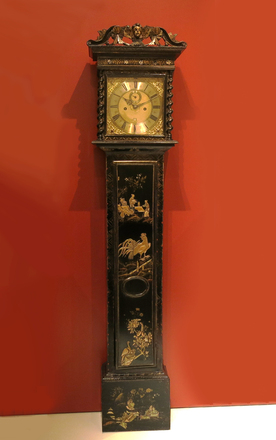
| http://collections.aucklandmuseum.com/ontology/core/researcherComments | clock, longcase, month duration rack and snail quarter strike on two bells, latched plates, five pillars, square brass dial with gilt cherub spandrels, dial finely punched and gilt with engraving around centre, chapter ring has ¼ hour divisions inside chapters and small five minute numerals outside minute divisions, 's-n' at top of dial, calendar aperture above 6 chapter, case is of oak with black lacquer on door, sides of trunk and plinth, and front of plinth, hood and front of plinth are painted, rising hood with right-handed barley twist columns, glazed sides, convex corner mouldings below hood, oval bull's eye in door. In the late 17th Century an invention that would transform timekeeping and permit previously unheard of levels of accuracy appeared: the pendulum clock. Within a decade, still before 1700, it was being applied even to domestic clocks, enabling in rare instances the creation of clocks which would run and strike accurately for an entire month on a single winding. The lovely longcase clock made in about 1690 by John Ebsworth, an important London maker, is a rare survivor from that era of exciting developments in the art and science of clockmaking. Its finely proportioned and lacquered Chinoiserie case with its rising hood, bulls eye glass showing its royal pendulum and its month duration striking movement together imply that it is important enough that its acquisition from England by donation in the 1970s required a special clearance from the British Government. We are privileged to have it in the care of the Auckland Museum so that it will always remain available for our enjoyment. David Smith, 22 June 2006 |
| http://erlangen-crm.org/current/P108i_was_produced_by | http://api.aucklandmuseum.com/id/humanhistory/object/17549/production |
| http://erlangen-crm.org/current/P138_has_representation | http://api.aucklandmuseum.com/id/media/v/31839 |
| http://erlangen-crm.org/current/P138_has_representation | http://api.aucklandmuseum.com/id/media/v/73264 |
| http://erlangen-crm.org/current/P138_has_representation | http://api.aucklandmuseum.com/id/media/v/73265 |
| http://erlangen-crm.org/current/P138_has_representation | http://api.aucklandmuseum.com/id/media/v/237542 |
| http://erlangen-crm.org/current/P138_has_representation | http://api.aucklandmuseum.com/id/media/v/237543 |
| http://erlangen-crm.org/current/P138_has_representation | http://api.aucklandmuseum.com/id/media/v/237541 |
| http://erlangen-crm.org/current/P1_is_identified_by | http://api.aucklandmuseum.com/id/humanhistory/object/17549/identifier |
| http://erlangen-crm.org/current/P24i_changed_ownership_through | http://api.aucklandmuseum.com/id/humanhistory/object/17549/acquisition/1 |
| http://erlangen-crm.org/current/P3_has_note | In the late 17th Century an invention that would transform timekeeping and permit previously unheard of levels of accuracy appeared: the pendulum clock. Within a decade, still before 1700, it was being applied even to domestic clocks, enabling in rare instances the creation of clocks which would run and strike accurately for an entire month on a single winding. The lovely longcase clock made in about 1690 by John Ebsworth, an important London maker, is a rare survivor from that era of exciting developments in the art and science of clockmaking. Its finely proportioned and lacquered Chinoiserie case with its rising hood, bulls eye glass showing its royal pendulum and its month duration striking movement |
| http://erlangen-crm.org/current/P3_has_note | The long case clock by important London maker, John Ebsworth, unites the art and science of clock making. Inside its finely proportioned and lacquered Chinoiserie case is a highly refined movement that will run and strike accurately for an entire month on a single winding. |
| http://erlangen-crm.org/current/P43_has_dimension | http://api.aucklandmuseum.com/id/humanhistory/object/17549/dimension/5 |
| http://erlangen-crm.org/current/P43_has_dimension | http://api.aucklandmuseum.com/id/humanhistory/object/17549/dimension/3 |
| http://erlangen-crm.org/current/P43_has_dimension | http://api.aucklandmuseum.com/id/humanhistory/object/17549/dimension/4 |
| http://erlangen-crm.org/current/P43_has_dimension | http://api.aucklandmuseum.com/id/humanhistory/object/17549/dimension/1 |
| http://erlangen-crm.org/current/P43_has_dimension | http://api.aucklandmuseum.com/id/humanhistory/object/17549/dimension/2 |
| http://erlangen-crm.org/current/P45_consists_of | http://api.aucklandmuseum.com/id/humanhistory/object/17549/material/1 |
| http://erlangen-crm.org/current/P45_consists_of | http://api.aucklandmuseum.com/id/humanhistory/object/17549/material/2 |
| http://erlangen-crm.org/current/P46i_forms_part_of | http://api.aucklandmuseum.com/id/humanhistory/object/17549/collection |
| http://erlangen-crm.org/current/P50_has_current_keeper | http://api.aucklandmuseum.com/id/humanhistory/object/17549/keeper |
| http://erlangen-crm.org/current/P51_has_current_owner | http://api.aucklandmuseum.com/id/humanhistory/object/17549/legalBody |
| http://erlangen-crm.org/current/P65_shows_visual_item | http://api.aucklandmuseum.com/id/humanhistory/object/17549/inscription/1 |
| http://purl.org/dc/elements/1.1/description | clock, longcase, month duration rack and snail quarter strike on two bells, latched plates, five pillars, square brass dial with gilt cherub spandrels, dial finely punched and gilt with engraving around centre, chapter ring has ¼ hour divisions inside chapters and small five minute numerals outside minute divisions, 's-n' at top of dial, calendar aperture above 6 chapter, case is of oak with black lacquer on door, sides of trunk and plinth, and front of plinth, hood and front of plinth are painted, rising hood with right-handed barley twist columns, glazed sides, convex corner mouldings below hood, oval bull's eye in door. |
| http://purl.org/dc/elements/1.1/title | clock, longcase |
| http://www.w3.org/1999/02/22-rdf-syntax-ns#type | http://erlangen-crm.org/current/E22_Man-Made_Object |


- Set the
Acceptheader toapplication/ld+jsonto get JSON-LD for this subject - Set the
Acceptheader toapplication/jsonto get simple JSON representation for this subject